
“Great businesses need more than capital. We invest, then we get to work.”
– Adam Horvath, Chief Strategy Officer, Tapio Capital
Operational investing means more than writing a cheque. An operational investor puts money into a business and then works inside it with the founder to build the parts that money can’t build by itself. The term gets used loosely, so I want to be clear about what an operational investor actually does, because it’s the work we do every day at Tapio Capital.
We back pre-Series A businesses and build the revenue function with the founder until it can run without us.
Capital buys runway, but execution creates value.
Raising money is hard. I know how much of a founder’s time it takes. However, once the cheque lands, most founders find the money was the easier part.
Funding buys time. But someone (usually the founder) still has to build the pipeline and set up a CRM that can tell you where your deals came from.
Most founders I meet at this stage have more ideas than hours in the day. Between first revenue and Series A, one person is often running product, sales, marketing, and the raise at the same time. So when the money arrives, the pull is to turn it into growth, fast. Some founders expect growth to follow the funding. Others hand it to an agency before they’ve actually taken the time to figure out who they sell to, and what they say to them.
When that doesn’t work, the usual reaction is to try harder and do more of the same. In our experience the better route is to slow down, understand the problem and how to solve it, then sharpen the message, and present it to the right audience.
Most founders don’t lack ideas. They lack capacity.
There are two gaps at this stage.
A junior hire, however good, can’t build that function from scratch on their own. Someone has to set the direction and show them what good looks like. If nobody does, the founder ends up managing the hire on top of everything else.
So the business has the money to grow, but not yet the experience to turn that money into a repeatable way of winning customers. That’s the gap an operational investor is there to close.
Most investors offer something beyond the cheque. With a traditional VC that’s usually strategic support, such as advice from the board and introductions. Good founders make real use of it. But advice still has to be turned into action by someone, and before Series A it tends to land back on the founder’s desk.
We know that sharpening an ideal customer profile (ICP) is easy advice to give. So, as an operational investor, we do the work inside the business, with the founder. We put experienced operators in early. They work to a shared rhythm with the founder, on the same CRM and the same numbers. Decisions are made together, and the founder runs the business throughout.
When founders ask me what that’s like, I tell them it’s a bit like gaining a senior team before you could afford to hire one.
It’s also how we describe Tapio: Great businesses need more than capital. We invest, then we get to work.
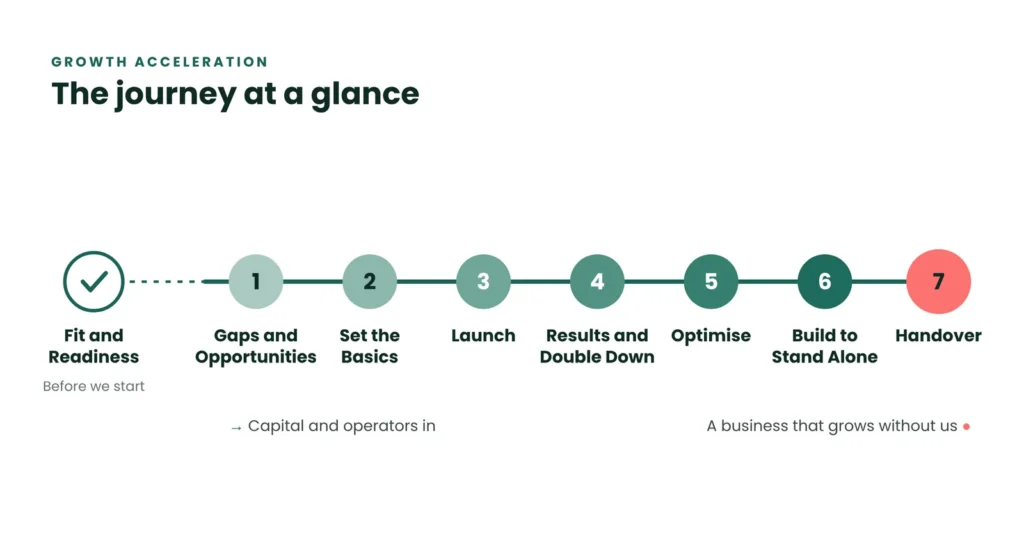
We call our approach Growth Acceleration. Before anything starts there’s Fit and Readiness, and after that seven stages: Gaps and Opportunities, Set the Basics, Launch, Results and Double Down, Optimise, Build to Stand Alone, and Handover. We don’t launch anything until the basics are in place.
A B2B hospitality platform we back is five months in. The website has been rebuilt and is live, and outbound now runs with lead scoring built into the CRM. A contact list that had gone dormant was re-engaged and booked a meeting in its first week. The first demo has now come in from a marketing newsletter.
None of it is big on its own. But it adds up to the start of a pipeline that doesn’t rely only on the founder.
Earlier this year, a founder described the squeeze to us better than I could:
“We’re the only people occupying that space, but we’re not loud enough in the market.
And on what would change it:
“Working with a team like you guys to do that, and actually operationalise that, is invaluable at this moment.”
A B2B founder
Operational investing has an end point, and it’s built in from the start. We build the revenue function and run it with the founder until it stands on its own. What we hand over is a working system to a team that knows how to use it. If the business still needs us to keep going, we haven’t finished the job.
For investors, this changes what a cheque does. The same capital goes further, because it arrives with the capacity to execute. And because the work happens inside the business, investors can watch risk come down month by month, rather than waiting for the next round to find out. Research backs this up: a study in the Journal of Finance found that when investors could get more involved with the startups they backed, those companies innovated more and were more likely to exit successfully.
We come in, professionalise the business, hand it over, and the founder takes it from there.
We work with pre-Series A, post-revenue businesses in B2B tech and fintech. The founder has proven that customers will pay, and now needs a revenue engine that doesn’t depend on them doing everything.
You’re likely a good fit if:
One email a month from Adam on what happens inside the businesses we back. There’s no edition in December, and from January we walk through Growth Acceleration one stage at a time.
An operational investor puts capital into a business and then works inside it, alongside the founder, to build what the capital alone can’t. At Tapio Capital, that means building the revenue function of a pre-Series A business until it stands on its own.
A traditional VC usually offers strategic support, such as advice and introductions. An operational investor like Tapio Capital does the work inside the business, with experienced operators working alongside the founder on the same systems and numbers.
When the business can grow without them. At Tapio, the final stage of Growth Acceleration is Handover: we hand over a working system to a team that knows how to use it, and the founder takes it from there.
Learn more about our impact or apply now and see how we can empower your startup.